Budd Wheel Impact Sockets: A Fleet Shop Guide to 4-Point and Square Sockets


Budd wheel work is its own category. The fasteners are big, the torque is high, and the socket has to fit the first time. Round off one of these on a heavy truck and the truck sits. That is the job we are protecting.
So before you grab a socket, let's go over what a Budd wheel impact socket is, why it is not shaped like a normal hex, how to pick between the sizes we carry, and what belongs on the truck and in the crib.
What makes a Budd wheel impact socket different
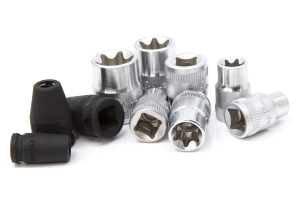
A standard impact socket has a hex opening, 6-point or 12-point, that grips the flats of a nut. A Budd wheel socket is built around a different engagement shape. Two of the sockets our customers buy most show the difference:
- The Genius Tools 866026S 13/16 inch square Budd wheel impact socket. It is 1 inch drive, with a 13/16 inch square opening and a 60mm (2.36 inch) overall length.
- The Genius Tools 649521S 21mm Budd wheel impact socket. It is 3/4 inch drive, with 4-point engagement and a 90mm length.
Remember this: the opening matches the fastener. You do not make the fastener match your socket. Put a hex socket on a square or 4-point and you will damage the fastener before you move it.
Square vs 4-point: match the socket to the fastener
The mistake I see most is ordering by size alone. Someone sees 13/16 and 21mm and figures they are close enough. They are not. One is an inch-size square opening on 1 inch drive. The other is a metric 4-point opening on 3/4 inch drive. Different fastener, different drive, different gun.
Start with the equipment, not the catalog:
- Pull a fastener, or check the wheel service documentation for the vehicles you actually work on.
- Check the drive size on the impact wrench you are using. If the shop runs a 1 inch gun for heavy wheel work, buy 1 inch drive sockets. Adapters work, but each one adds length and another joint that wears.
- Match the opening shape (square, 4-point, or hex) and the size exactly.
That sounds basic. But a mixed fleet with older and newer trucks can have more than one Budd style in the same yard. That is where a second socket in the crib earns its spot.
Why CR-Mo steel matters on impact sockets
Both of these Budd sockets are made from Chromium Molybdenum alloy steel. That is what you want on an impact-rated tool. The product pages also list heat treatment and a matte or black oxide finish, which helps with grip and corrosion in a shop.
Here is why it matters. Chrome vanadium is a good hand tool steel, and we sell plenty of it. But an impact gun does not pull smooth. It hammers, over and over. Impact sockets are built for that load. If you are running a Budd socket on a 1 inch gun, it needs to be an impact-rated CR-Mo socket. If you want the longer explanation, read our post on why impact sockets matter for safety and tool life.
Socket length and access
Length is the spec people skip. The 866026S is a compact 60mm overall. The 21mm 649521S is 90mm. Neither is better. The job decides.
A shorter socket keeps the gun close to the wheel. That gives you more control and less wobble. A longer socket gives you clearance around the hub and the tire. If you keep reaching for an extension on the same job, that tells you the shop needs a longer socket for it, not another extension in the stack.
Building a Budd wheel kit for a fleet or government motor pool
If you are setting up a wheel service kit for a fleet, build it in three layers:
- Primary sockets: the exact Budd sockets that match the fasteners on your vehicles, in the drive size of your main impact wrench.
- Backups: a second of the size you use most. Sockets walk off, get left on a road call truck, or get damaged on the wrong gun. A spare keeps the bay working.
- Support tools: the adapters, extensions, and larger impact sockets for the rest of the heavy equipment you service. Most of that is in our impact sockets category, all the way up to big 1 inch drive sizes like the 3-1/16 inch 867098.
If you buy for a government or institutional shop, write the spec the same way: drive size, opening shape, opening size, overall length, and material. When the purchase request lists all five, nobody has to guess, and you do not end up with a 3/4 inch drive socket for a 1 inch gun.
Identification and tool control
Both sockets have permanently stamped size markings. That seems minor until you run a tool control program. In a fleet shop or a government facility where tools get checked in and out, a socket you can read is faster to sort, faster to audit, and less likely to end up in the wrong drawer.
My problem with cheap unmarked tools is not only quality. They slow everyone down. If you have to measure a socket to find out what it is, the shop is paying a technician rate for sorting.
Care and inspection
Impact sockets take a beating. A few habits make them last:
- Check the drive end and the opening for cracks or flaring, especially after a fastener that fought you.
- Keep the drive square clean so the socket seats fully on the anvil.
- Never put a hand socket on an impact gun to save a trip to the box. That is how sockets crack.
- Store heavy sockets where they will not get dropped on concrete every day.
When you retire a socket, look at why it failed. If the same size keeps wearing out, the job, the gun setting, or the fastener condition is telling you something. Talk it over with the rest of the shop.
Warranty and what it covers
Genius Tools are backed by the Genius Tools Limited Lifetime Warranty against manufacturer defects. It does not cover abuse, misuse, or normal wear, so the care habits above still matter. If you have a question about a specific claim, ask our team and we will go through it with you.
Value without cutting corners
Budd wheel sockets are not the place to gamble. That does not mean you need the most expensive one on the shelf. Genius is built for professional technicians, with CR-Mo steel, heat treatment, and stamped markings, at a price that makes stocking spares realistic. For a fleet manager or a supply house, that is the difference between owning one socket and owning the two or three the job needs.
Buying for resale or for a large fleet
If you run an industrial supply house, resell tools, or buy for a large fleet or agency, talk to us directly instead of building orders one socket at a time. Tell us which vehicles or equipment you support and the drive sizes your customers run. We will help you put together the right mix of Budd wheel sockets and the impact sockets around them.
FAQ
Can I use a hex impact socket on a Budd wheel fastener?
Only if the fastener is a hex. The 866026S has a square opening and the 649521S has a 4-point opening for a reason. Match the opening shape to the fastener.
What drive size do I need?
Match the drive on your impact wrench. The 866026S is 1 inch drive. The 649521S is 3/4 inch drive.
Are these sockets impact rated?
Yes. Both are Chromium Molybdenum alloy steel for impact use, with heat treatment and a protective finish.
Do they have a warranty?
Yes, the Genius Tools Limited Lifetime Warranty against manufacturer defects.
Not sure which Budd socket fits your equipment? Send us the vehicle or wheel details and we will help you sort it out before you order.